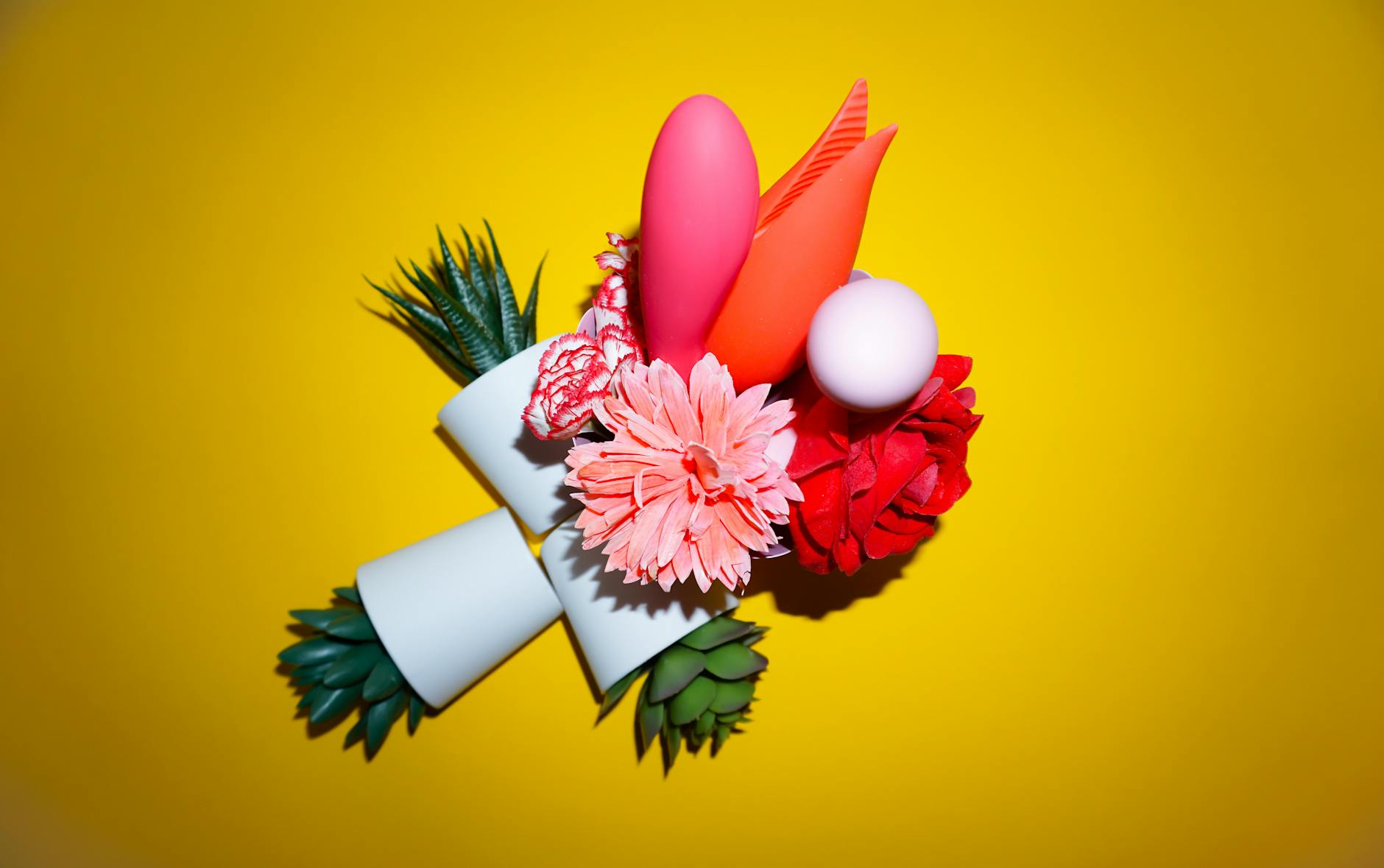
Why Lemon Clitoral Vibrators Work Better During Hormonal Transitions
Let's be real. Your body doesn't feel the same all month. Hormonal shifts reshape how sensation registers, how quickly you build arousal, and how intense stimulation needs to be to actually register. Most vibrators ignore this fact entirely. They just buzz at the same frequency whether you're in the follicular phase, ovulating, or riding a hormone dip. Which is why so many people find that their favorite toy stops working the way it used to.
Lemon clitoral vibrators, specifically the air-suction style, work differently. They respond to your anatomy instead of demanding your anatomy adapt to them.
How hormones actually change sensation
Estrogen and progesterone don't just control whether you want sex. They reshape the tissue itself. During the high-estrogen phases of your cycle (or if you're on hormonal birth control), your vulva has thicker tissue, more blood flow, and nerves sitting closer to the surface. Touch feels bigger, faster, more pronounced.
Then progesterone rises, or estrogen drops, and everything inverts. The tissue thins slightly. Blood flow slows. Nerves feel more muted. The same vibration that felt perfect three weeks ago now feels like static.
This isn't your imagination. It's measurable. Studies on vibrotactile sensitivity show that women report needing 15-25% more intensity in the luteal phase than the follicular phase. Some people swing even wider.
The problem with traditional bullet vibrators or wands is mechanical. They deliver a fixed amount of vibration to a fixed surface. On high-estrogen days, that's fine. On low-hormone days, you're working harder to feel anything, or you're fighting to keep it from feeling sharp and overstimulating.
Why suction changes the game
Suction technology works on a completely different principle. Instead of vibration alone, it creates a gentle seal and rhythmic pulse that mimics the sensation of oral stimulation. The key word there is gentle. And variable.
When you're in a low-sensation phase, suction doesn't need to get louder to feel more intense. The seal itself intensifies the sensation because it's engaging more nerve tissue at once. You're not fighting friction. You're working with your body's anatomy.
Lemon vibrators use air-pulse technology specifically because it adapts more naturally to tissue changes. A light pattern on the Lemon can feel more satisfying than a medium setting on a traditional vibrator, even though it's delivering less raw power. The sensation is concentrated, not scattered.
This matters during hormonal transitions especially. If you're moving through perimenopause, cycling on and off hormonal birth control, or dealing with irregular cycles, your baseline sensation is in flux. You need a tool that can dial with you, not against you.
The tissue thinning problem (and why suction solves it)
During low-hormone phases, the clitoral tissue gets thinner. This is particularly pronounced during perimenopause, when estrogen levels are bouncing around unpredictably. Thinner tissue means:
- Direct vibration can feel sharp or uncomfortable
- You need longer warm-up time to build sensation
- Your arousal threshold shifts (takes longer to build)
- Orgasm might feel different. Sometimes duller. Sometimes more concentrated and almost hypersensitive.
Traditional vibrators respond to this by cranking the setting higher. Which sometimes works, but often just makes you feel raw.
Lemon clitoral vibrators approach it differently. The suction spreads stimulation across a wider surface area. Even on gentle patterns, you're engaging the entire clitoral complex, not just the tip. That distributed sensation works better on thinner, more sensitive tissue because it doesn't concentrate force on one small area.
If you've noticed that your usual toy feels too intense during certain phases, or you have to dial way down and then feel like you're missing the sensation entirely, a Lemon vibrator sits in that middle ground. You're not sacrificing intensity to stay comfortable.
When your baseline shifts: age and hormonal birth control
Hormonal transitions aren't just about your monthly cycle. They're about bigger life shifts.
If you've just started or switched birth control, your tissue is adjusting to a new hormone dose. Some pills thin tissue slightly. Some maintain thickness. Some actually increase blood flow and sensitivity. Every body responds differently, which means your favorite vibrator might suddenly feel wrong.
That adjustment takes 2-3 months usually. During that window, you need flexibility. A Lemon vibrator's range from barely-there to intense lets you track what your body actually needs each day instead of committing to one sensation profile.
The same applies when you're moving into perimenopause or experiencing hormonal changes from health conditions. Estrogen fluctuates wildly during perimenopause. Some days you're in a high-sensation phase. Some days you feel completely numb. Having a toy that can shift with you saves you from buying three different devices.
You can also learn more about how Lemon vibrators help when sensation changes during perimenopause for deeper dives into that specific life stage.
The warm-up variable
Hormones also control how quickly your body responds to stimulation. High estrogen? You warm up fast, sometimes in minutes. Low estrogen or progesterone-dominant phases? You might need 15-25 minutes to build any sensation.
This is where a Lemon vibrator's pattern variety becomes genuinely useful. It's not just that there are multiple speeds. It's that you can start on a gentle, rhythmic pattern that mimics what your body naturally does during arousal, rather than jumping straight into buzzing intensity.
Many people find that starting with a light suction pattern, then gradually increasing, feels way more natural than trying to go from zero to medium on a traditional vibrator. It mirrors the way your body actually builds arousal, which means you're working with your physiology instead of against it.
If you're in a phase where warmup is tough, spending 5-10 minutes on pattern 1 or 2 on a Lemon often gets you to full arousal faster than spending 20 minutes with a stronger toy. You're not fighting to feel something. The sensation builds naturally.
Dealing with inconsistent arousal across your cycle
One of the most frustrating parts of hormonal transitions is inconsistency. You might be someone who orgasms easily in the follicular phase and struggles during ovulation. Or the opposite. Or you might experience a window where you feel nothing, then suddenly hypersensitive.
That unpredictability makes it hard to know which toy to use. A Lemon clitoral vibrator handles all of those phases in one device because the suction mechanism doesn't require precise calibration the way traditional vibrators do.
The range is broad enough to meet you wherever you are that day. You're not choosing between "too gentle" and "too intense." You're actually finding the sweet spot.
This is particularly valuable for people managing health conditions that affect hormones (PCOS, endometriosis, thyroid issues) or taking medications that interact with hormonal sensitivity. Your baseline might shift weekly. A flexible tool is an investment.
The science of what makes air-pulse work
Air-suction or air-pulse technology operates on a principle called summed sensation. When you apply gentle pulsing pressure to a tissue that has relatively low sensitivity, the repetition itself creates perceived intensity. Your nervous system adds up the pulses rather than treating each one separately.
This is why even on a low setting, a Lemon vibrator often delivers more satisfying sensation than a traditional vibrator on a higher setting. It's not a marketing claim. It's documented in sensory neurology research.
During hormonal phases where your baseline sensitivity is already low, summed sensation is your friend. You're not fighting to cross a sensation threshold. The pulsing itself creates the intensity your nervous system is looking for.
If you're dealing with reduced clitoral sensitivity from any cause, lemon vibrators and similar suction devices frequently outperform conventional vibrators. You can read more about how to use lemon vibrators for better sensation when you have reduced clitoral sensitivity for strategies on that front.
What to look for if you're switching during a transition
If you're moving through a hormonal change and your usual toy stopped working, here's what matters:
Pattern variety. You need at least 5-7 distinct patterns, ideally ranging from slow and rhythmic to faster and more complex. This lets you actually match your current sensitivity.
Intensity range. The jump between lowest and highest should feel smooth, not binary. Many traditional vibrators go from "barely on" to "extremely intense" with nothing in between. That doesn't work during transitions when your sweet spot might be relatively narrow.
Gentle default. The lowest setting should be genuinely gentle, not just "less intense." If the lowest speed is already pretty aggressive, you're limited to high-hormone phases.
Responsive technology. Suction or air-pulse devices adapt to your anatomy in ways traditional vibration doesn't. They respond to how you use them, not just deliver the same sensation regardless.
A Lemon clitoral vibrator checks all of those boxes. It's designed specifically so that someone in a low-sensation phase can build genuine pleasure without waiting three weeks for their hormones to cooperate.
The permission piece
Here's something that doesn't get talked about enough. Hormonal shifts don't just change sensation. They change desire. And that messes with people psychologically.
If you've always been someone who orgasms easily in the follicular phase, then enter a progesterone-dominant phase and struggle, that's destabilizing. You start wondering if something's broken. If you're losing interest in sex. If your body is betraying you.
It's not. It's hormones. And a tool that works smoothly across all your phases (instead of only working half the month) is actually permission to relax about it. You're not choosing between fighting your body or giving up on pleasure. You're using something that matches your actual neurology.
That permission matters more than people usually admit.
People Also Ask
Do Lemon clitoral vibrators really work better for hormonal sensitivity?
Yes, measurably. Air-pulse or suction technology engages more tissue surface area than traditional vibration, which means light pressure creates satisfying sensation even during low-hormone phases. The summed sensation from pulsing patterns also activates nerve responses that traditional vibrators struggle to achieve when baseline sensitivity is low. For people cycling through hormonal changes, a Lemon vibrator's pattern range usually means you're not hunting for the right toy throughout your cycle.
Can you use a Lemon vibrator during all phases of your cycle?
Absolutely. That's actually the design point. During high-estrogen phases, you might use faster or more intense patterns. During low-hormone phases, you'd stay on gentler settings. But you're using the same device across all phases, which saves you from investing in multiple toys. The range is built in.
What's the difference between suction and traditional vibration during low-hormone phases?
Traditional vibration delivers force to a small focal point, which feels sharp or numbing during low-hormone phases when tissue is thinner and less responsive. Suction distributes stimulation across a wider area and relies on pulsing rhythm rather than pure frequency, which creates satisfying sensation even when baseline sensitivity is down. Think of it as the difference between vibrating intensity versus rhythmic pressure.
How long does it take to adjust to a Lemon vibrator if you usually use traditional vibrators?
Most people notice a significant difference within the first 2-3 sessions. Your nervous system responds quickly to the different stimulation pattern. However, true preference alignment (where you understand all the patterns and find your favorites) usually takes 1-2 weeks of regular use. Give yourself at least that window before deciding if it's right for you.
Is a Lemon vibrator helpful if you're on hormonal birth control?
Yes. Hormonal birth control suppresses cycle-related hormone fluctuation, but it doesn't eliminate sensitivity variation. Some people feel more consistent sensitivity on birth control, while others experience baseline shifts in sensation. A Lemon vibrator's range and adaptive patterns help navigate whichever experience you're having. It's particularly useful if you're switching pill formulations or trying a new hormone dose.
Can lemon vibrators help if you're in perimenopause?
Absolutely. Perimenopause is characterized by erratic hormone fluctuation, which means your sensation baseline can shift week to week. A flexible tool like a Lemon vibrator that works across wide sensitivity ranges is genuinely useful during this phase. Many people in perimenopause report that suction devices feel more effective than traditional vibrators precisely because they adapt to unstable tissue conditions.
What comes next
If hormonal transitions have been reshaping your pleasure in ways that frustrate you, the problem probably isn't you. It's that your tool isn't matching your biology. Lemon clitoral vibrators work with hormonal shifts rather than against them because air-pulse technology responds to your actual anatomy instead of demanding fixed performance.
Your pleasure matters across all phases. Not just the easy ones. A good vibrator should adapt to that.
Ready to explore what works for your body? Get in touch with us and let's talk about what you're actually experiencing. We're here to help you find the right fit.